
AI in Food Tracking: Real-Time Database Insights
The best AI food apps can log meals in seconds, but they still often miss by a lot. In one 2026 NIH study, apps undercounted meals by 250 to 345 calories per meal. The main reasons were simple: the app guessed the wrong portion, missed hidden fats like oil or butter, or used old nutrition data.
Here’s the short version: food recognition is getting better, but database updates and portion sizing still decide whether your log is close or off. Top systems now report about 90% to 95% food ID accuracy, but mixed dishes, restaurant meals, and home cooking still cause problems. And even if the app names the food right, the calories can still be wrong if the nutrition entry is outdated.
If I had to boil the article down, I’d put it like this:
- Portion size is still the biggest problem, making up about 60% of calorie estimate error
- Depth and LiDAR tools help, cutting portion error from about 27% to 12%
- Mixed meals are hard, especially when sauces, oils, and butter aren’t visible
- Database updates matter as much as image recognition
- Barcode scans help most with packaged foods
- Photo + text notes beat photo-only logging for restaurant meals and mixed dishes
- Verification matters, because messy food entries lead to messy macro and calorie totals
AI calorie tracking apps may be way off
Quick Comparison
| Area | What the article shows |
|---|---|
| Food ID | Top calorie tracking apps now reach about 90%–95% top-1 accuracy |
| Portion sizing | Still the main source of error |
| Hidden fats | Often missed; apps underreported about 30 g of fat per meal in one controlled study |
| Database quality | Old entries can skew calories and macros even when food ID is right |
| Best use case | Packaged foods with barcode scans |
| Hardest meals | Restaurant dishes, mixed meals, and home-cooked foods with extra fats |
| Best user fix | Adjust portions manually and log oils, butter, and sauces separately |
The bottom line is simple: an AI app is only as good as its portion estimate and its database. That’s the lens I’d use for the rest of the article.
How AI Identifies Foods and Estimates Portions
AI food tracking usually follows a clear sequence: it spots the food, labels each item, estimates the amount, and then turns that into calories and macros. Newer vision-language models do a better job with mixed plates than older CNN-based systems. In lab tests, top systems now hit 90% to 95% top-1 accuracy, up from about 72% in 2023. At this point, the big issue isn't whether AI can see food on a plate. It's how often it gets both the food and the portion right. Our explainer on how AI food tracking works walks through each stage of that pipeline.
Food Recognition Accuracy in Research Studies
Lab results and day-to-day use are not the same thing. Researchers often use Mean Absolute Percentage Error (MAPE) to track estimate error. Welling reports 95.6% to 96.8% food ID accuracy and ±1.2% to ±2.8% MAPE, while MyFitnessPal comes in at 72.4% and ±7.9%.
Across most non-leading platforms, fully autonomous recognition lands within ±5% error in only 61% of meal events. Welling's higher food ID accuracy matters, but only if that recognition connects to a current food database.
Even when the app identifies the food correctly, portion size can still cause most of the calorie miss.
Portion Estimation and Calorie Error Ranges
Portion size is still one of the biggest trouble spots. Historically, it accounts for about 60% of total caloric estimation error. The reason is pretty simple: a flat photo can't reliably tell whether that chicken breast is 4 ounces or 8 ounces.
New depth-based models try to fix that by estimating 3D volume from a photo or with LiDAR. That cuts portion error from about 27% to about 12%. Still, it helps to step in when something looks off.
A few cases deserve extra care:
- Manually adjust portions when the estimate seems wrong
- Log oils, butter, and sauces separately
Those gains show up most clearly on simple plates. Mixed meals are still where things get messy.
Where AI Falls Short with Mixed Dishes and Restaurant Meals
AI works best with single-ingredient foods. It has a much harder time with mixed dishes and restaurant meals, where sauces, toppings, and hidden layers can throw off both food ID and portion estimates. Fat is the nutrient most often underestimated across tested apps, and controlled studies show these apps miss about 30 grams of fat per meal.
For restaurant food, the best fix is to pair the photo with a chat or text note that explains how the dish was made. A short note like "fried in oil", "creamy sauce", or "extra butter" can make a big difference. Platforms that support multimodal input keep beating visual-only systems on these tougher meals — a pattern we also found in our photo logging vs manual entry comparison.
That matters even more when the food database is old or missing entries. An app can recognize the meal on sight, but if the nutrition entry is incomplete, the final log can still be off.
How Real-Time Database Updates Affect Nutrition Accuracy
Once an app identifies a food, the next step is the database behind it. And that step can make or break the final result.
If the source is old or missing the item, the log is off. Even when the app recognizes the food correctly, stale nutrition data can still lead to the wrong calorie count. So database freshness matters just as much as image recognition.
USDA FoodData Central, Branded Foods, and Restaurant Data
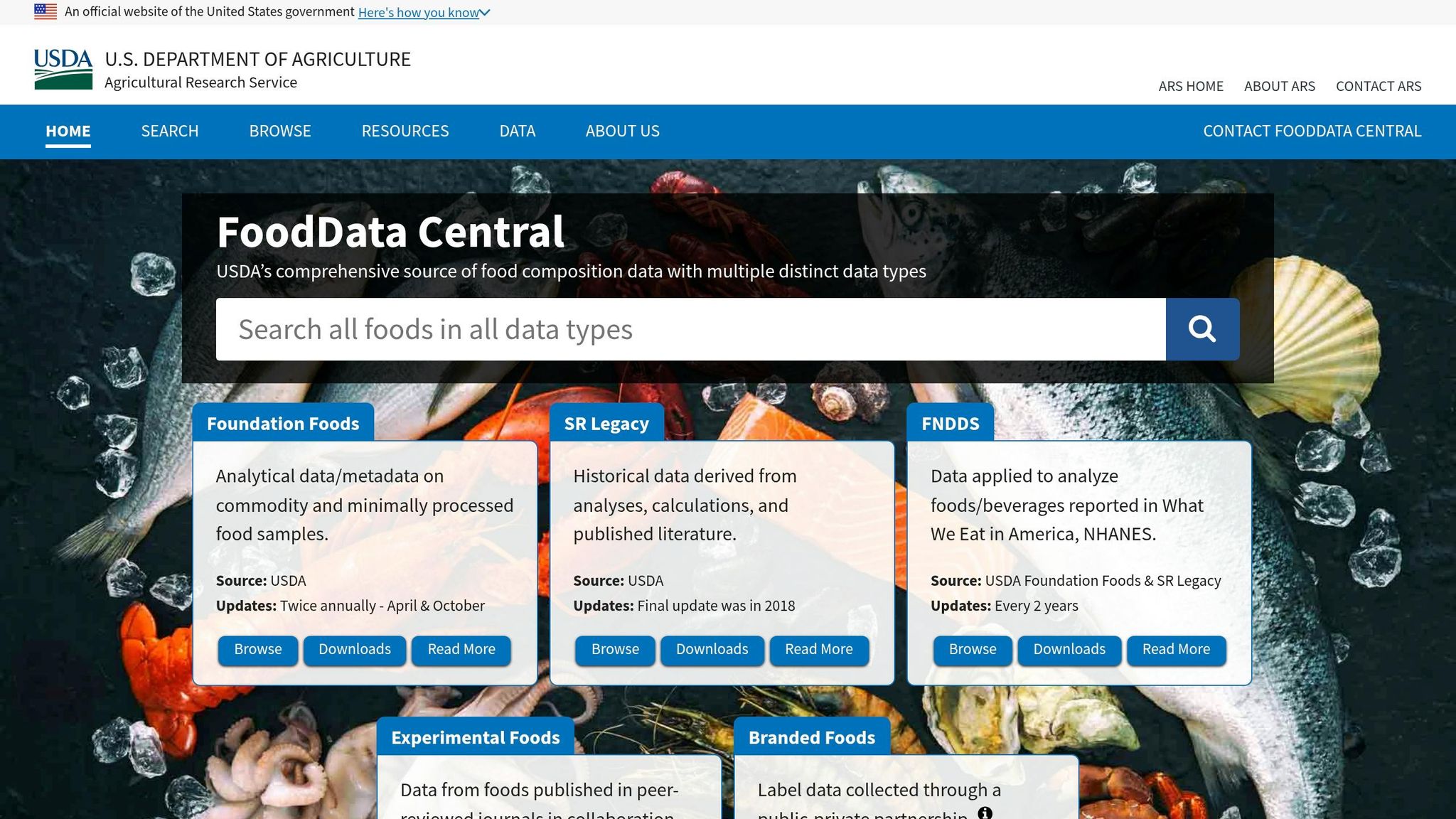
The big issue isn’t access. It’s coverage.
USDA FoodData Central is the main U.S. nutrition database, with more than 370,000 entries across the Foundation, Survey (FNDDS), Legacy, and Branded databases.
That said, USDA data by itself doesn’t cover everything people eat in daily life. Products get reformulated. Restaurant menus change. And small “invisible” ingredients like oils, butter, and dressings can shift the calorie total in a meaningful way. For packaged foods, barcode scanning is often the best option because it pulls manufacturer Nutrition Facts straight from the source.
Static vs. Frequently Updated Food Databases
The gap between static and frequently updated databases shows up fast with new products and reformulated foods. Static databases tend to trail behind product launches and menu updates. Frequently updated databases pick up those changes much sooner.
| Feature | Static Databases | Frequently Updated Databases |
|---|---|---|
| What it captures | Standard ingredients and older branded data | New reformulations, seasonal restaurant items, global cuisines |
| Update frequency | Annual or multi-year cycles | Weekly or real-time through API updates and user corrections |
| Error risk | High risk of missing "invisible" fats and new product ingredients | Lower error via preparation-specific profiles and verified branded data |
| MAPE | 28–34% (2023-era benchmarks) | 1.2%–5% (2026-era benchmarks) |
That accuracy gap isn’t small. Welling has reported MAPE as low as 1.3% in prospective validation studies, compared with the 28% to 34% range seen in older static systems.
This is where the difference becomes easy to see. A static database may still list last year’s nutrition profile, while a frequently updated one reflects a new recipe, a seasonal menu item, or a package reformulation. Same food name, very different result.
How Verification Workflows Affect Data Trust
Not all database entries carry the same weight.
Welling uses verified catalogs that cross-reference USDA data with validated branded records, plus an active-learning loop that folds user corrections into weekly retraining. That setup helps cut down duplicate entries and mismatched records, which are common problems in crowd-sourced databases.
In practice, verification affects every logged meal. If the underlying entry is messy, the output will be messy too. Verified, frequently updated data is what makes AI food tracking useful for day-to-day logging.
How Current Apps Apply AI Tracking and Database Maintenance
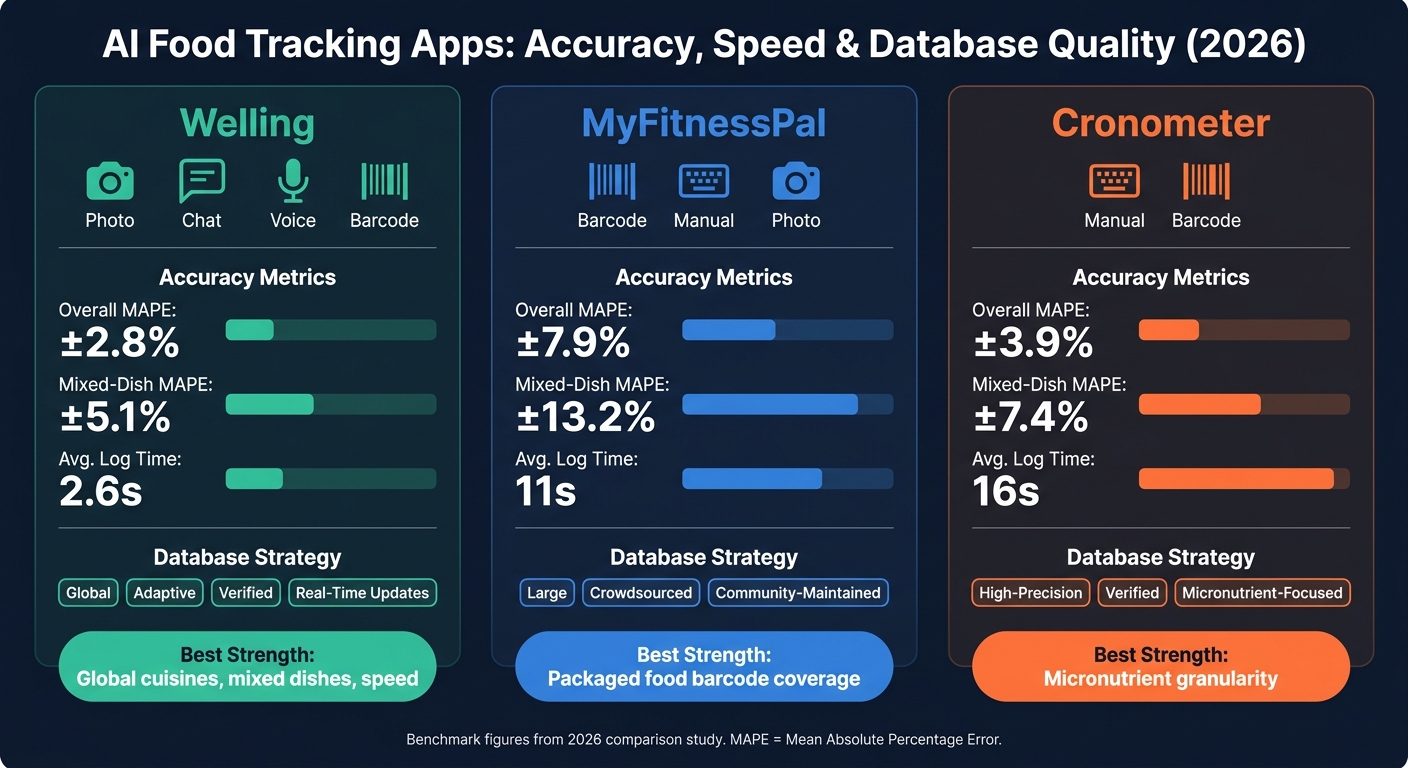
AI Food Tracking Apps Compared: Accuracy, Speed & Database Quality (2026)
These database tradeoffs show up in a very direct way: how each app logs meals. Welling, MyFitnessPal, and Cronometer all handle that job differently, and those choices shape speed, ease of use, and logging accuracy.
Welling's Photo, Chat, and Real-Time Nutrition Feedback
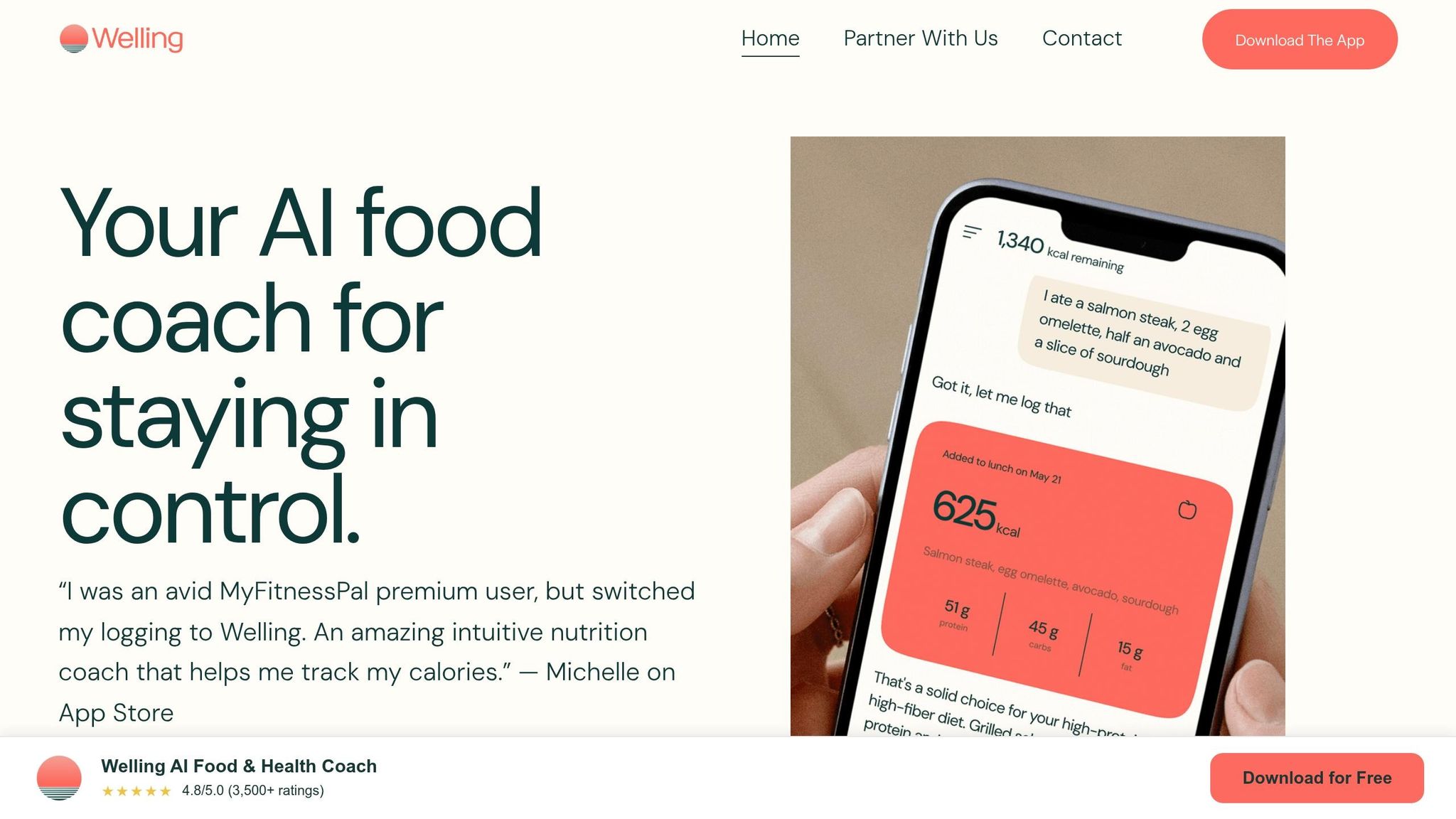
Welling combines photo, chat, voice, and barcode logging with a global food database and real-time feedback. It also learns from each user's repeat meals and serving habits, so recognition can get better over time.
That matters because food logging isn't just about spotting what's on the plate. It's also about matching that food to the right entry, portion, and nutrition data without slowing the user down.
The same accuracy problem plays out differently in MyFitnessPal and Cronometer, where database strategy has a bigger effect than recognition alone. This is a key consideration for those looking to automate weight loss tracking effectively.
How MyFitnessPal and Cronometer Differ on Database Strategy
MyFitnessPal leans on a large crowdsourced database with strong packaged food coverage. The tradeoff is scale over consistency. You get a lot of entries, but quality can vary.
Cronometer goes the other way. It focuses on verified, high-precision data with deep micronutrient detail. That's helpful for granular tracking, but it usually means more logging friction.
App Comparison: Logging Modes, Database Breadth, and Accuracy
The table below isolates the main differences that shape day-to-day logging accuracy.
| Feature | Welling | MyFitnessPal | Cronometer |
|---|---|---|---|
| Logging modes | Photo, Chat, Voice, Barcode | Barcode, Manual, Photo | Manual, Barcode |
| Database strategy | Global, adaptive, verified; real-time updates | Large, crowdsourced; community-maintained | High-precision, verified; manual and verification-focused |
| Strengths for U.S. users | Global cuisines, mixed dishes, speed | Packaged food barcode coverage | Micronutrient granularity |
| Overall MAPE | ±2.8% | ±7.9% | ±3.9% |
| Mixed-dish MAPE | ±5.1% | ±13.2% | ±7.4% |
| Avg. log time | 2.6s | 11s | 16s |
Benchmark figures in the table are from the 2026 comparison cited as [8]. Our own numbers come from the Food Tracker Compass 2026 benchmark.
Conclusion: What the Research Says About the Future of Food Tracking
AI has made food logging faster. But speed and accuracy are not the same thing.
Across the studies above, the pattern is pretty clear: a 2026 NIH study found that popular apps undercounted meals by 250 to 345 calories on average. At the same time, food ID performance across leading apps is starting to look similar, with median accuracy reaching 86% in 2026. So yes, apps are getting better at naming what's on the plate. The harder part is still figuring out how much of it is there.
That gap matters. Identifying a food correctly is one step. Estimating it with accuracy is another. Portion models have gotten better, but error hasn't gone away. And even when the portion math is solid, the result can still fall apart if the database entry is stale or missing.
That is why database freshness matters just as much as model quality. In 2026 benchmarks, the top-performing app had 94% of its packaged food data within ±5% of current labels, while bottom-tier apps were between 52% and 64%. In plain English: two apps can recognize the same food, but if one pulls from old or incomplete nutrition data, the log can still be off by a lot.
Mixed dishes and restaurant meals are still the hardest cases. Hidden fats like cooking oils and butter don't show up well in photos, and mixed meals are still tough to break apart with accuracy. Apps like Welling try to close that gap with photo, chat, and voice logging. Even so, manually logging cooking fats is still a smart move on any platform.
Key Points to Carry Forward
A few takeaways stand out:
- Recognition is getting better, but the real difference starts after the app identifies the food. Portion estimation is still the biggest source of error, and it has historically caused about 60% of total caloric estimation error, though leaders like Welling have cut that to about ±1.2%.
- Database freshness is a system-level problem. Old or incomplete entries can skew logs even when the app correctly identifies the food.
- Mixed dishes, restaurant meals, and hidden fats are still the biggest blind spots.
- Validation metrics matter more than marketing claims. Look for apps that share clear accuracy metrics, confidence bands, and database freshness data instead of just bragging about database size — our scoring methodology explains how we weigh each of those.
The number of misclassifications is converging; the macro errors of those misclassifications are not.
Database quality decides whether a calorie estimate is useful or just precise-looking noise.
FAQs
Why are AI food apps still off on calories?
AI food apps can miss calories for a simple reason: a photo doesn't tell the whole story.
Hidden, calorie-heavy ingredients like oils, butter, and dressings often don't show up clearly in an image. So even when the app identifies the food, it can still miss a big chunk of the meal's total calories.
Another issue is the tech many apps still rely on. A lot of them use older image models and 2D portion estimates, which can throw off portion sizing. And when portion size is wrong, calorie counts usually drift off too.
Some apps, including Welling, try to fix this gap with tools like 3D volume inference, multimodal reasoning, and natural language input. That mix helps them estimate food more accurately than older tracking tools, especially when the image alone isn't enough.
What foods are hardest for AI to log accurately?
AI has the hardest time with foods where the most important details don’t show up in a photo. Think cooking oils, butter, salad dressings, or the fat level in certain cuts of meat. A camera can see the dish, but it can’t always tell what was used to make it.
It also tends to trip over foods that look the same all the way through, like soups, smoothies, and purees. The same goes for regional dishes, fusion meals, and foods that may not show up often in training data. Welling gets around some of this by using a global food database and letting people add natural-language input for extra detail and clarification.
How do real-time database updates improve food tracking?
Real-time database updates make food tracking more accurate. They help AI match identified foods to standardized nutrition data, including calories, macronutrients, and micronutrients.
Apps like Welling push this further with a large global database and verified entries. That means fewer duplicates, fewer outdated listings, and more precise tracking for details like fiber and sodium.